d-AI-logue
On behalf of the National Centre for Social Research (EKKE):
Adj. Lecturer Michalis Tastsoglou, Ass. Prof. Michalis Chatzikonstantinou, Ass. Prof Achilleas Karadimitriou
Programme: d-AI-logue, Research and Educational Project, Project Partners: National Centre for Scientific Research “Demokritos”, National Centre for Social Research (EKKE), Archimedes/Athena Research Centre, World Human Forum
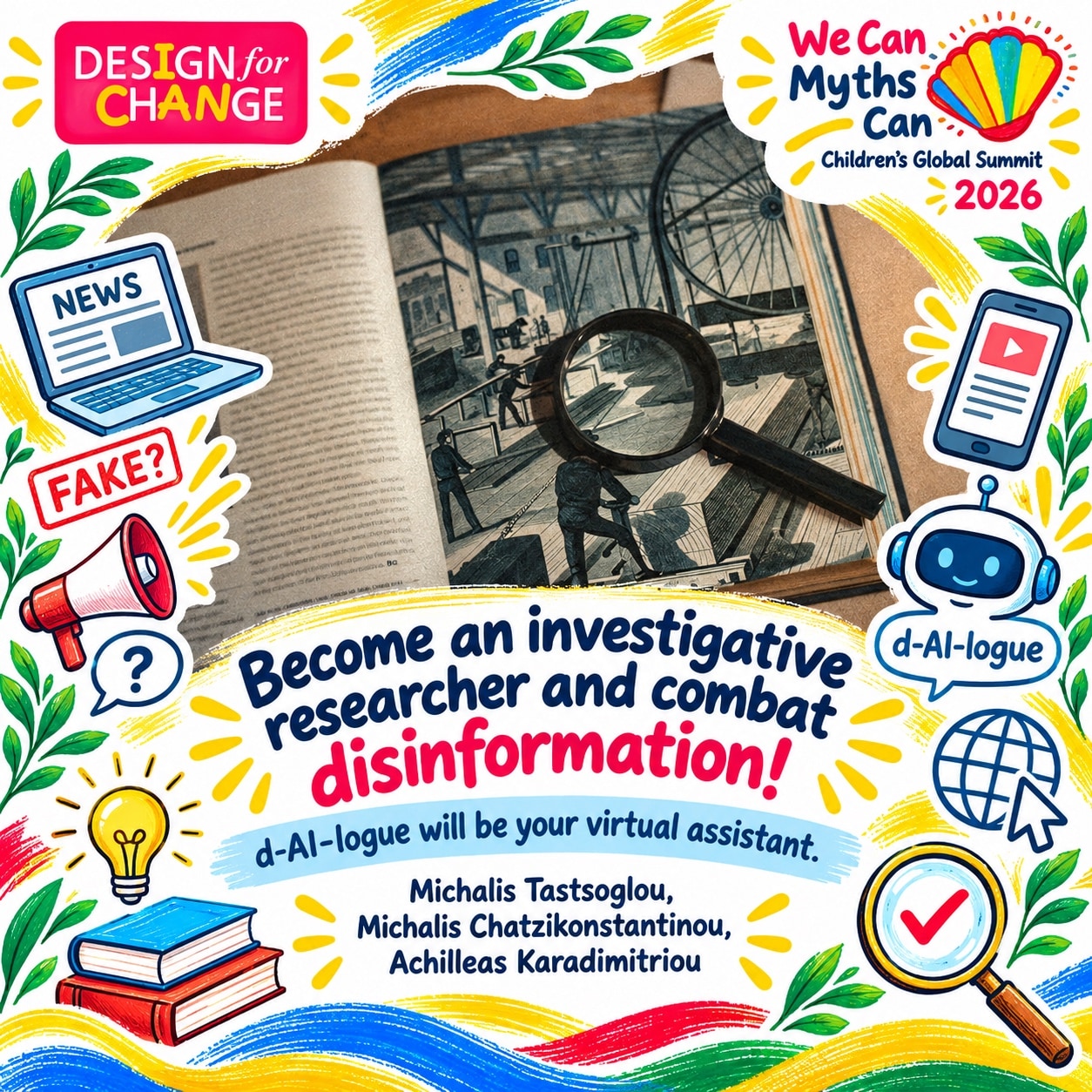
We all encounter news and information through social media and Generative AI (GenAI), where misleading content can be difficult to recognize. In this workshop you will understand how disinformation works and how to question what you see online.
Combining interactive brainstorming, group activities, real-world examples and a live demonstration of d-AI-logue virtual assistant, you will take the role of investigative researchers.
You will explore common manipulation techniques, analyse misleading posts and learn practical ways to assess the reliability of online information. Also, you will have the chance to use yourself the d-AI-logue educational platform and virtual assistant in order to spot manipulation tactics that are right in front of you.
Welcome, Facilitator Introductions & Diagnostic Ice-Breaker
- a) Rapport Building & Project Framing
- b) 60-second Interactive Diagnostic Poll
Gamified Theoretical Framing: Brainstorming & “The Big Picture”
- Participatory Brainstorming
- Mapping “The Big Picture” through Gamification
- The Architecture of Deception
Experiential Exercises (Part I): Typologies & Disinformation Techniques in Practice
- Small group Inquiry / Newsroom Lab
- Lower Secondary Differentiation – Analysis of clickbait and sensationalist content
Upper Secondary – Examination of cognitively demanding techniques
Experiential Exercises (Part II): Demonstration & Application of Fact-Checking
- a) Evidence-Based Debunking /Fact-Checking in Action
- b) Rapid Evaluation Protocol
Live Demonstration (Live Demo) of the d-AI-LOGUE Platform & Critical Stance Toward AI
- a) How to use the d-AI-logue Platform
- b) Guided discussion: the risk of uncritically delegating human reasoning and evaluative judgment to Large Language Models
Critical Reflection, Plenary Discussion & Synthesis of Key Takeaways
- a) Reflective Feedback Look & Q&A
- b) Empowering Epistemic Agency: moving to responsible digital citizenship
What Participants Will Take Away
Participants will achieve clearly defined learning outcomes in three dimensions: knowledge, skills and attitudes.
Specifically they will:
- Understand what disinformation is and how it differs from misinformation and other forms of harmful content;
- Explore how false and misleading information spreads online and why people believe it;
- Understand how AI works, its limitations, and how to use the d-AI-logue platform to think more critically about online information;
- Distinguish in practice among diverse disinformation genres and persuasive tactics;
- Interact purposefully and critically with dialogic digital environments such as the d-AI-LOGUE platform;
- Cultivate sustained critical vigilance, reflexivity, and personal responsibility toward the information they consume, evaluate, and recirculate across digital networks;
- Adopt an active, independent intellectual disposition to algorithms or Artificial Intelligence tools;
- Recognise that mitigating disinformation constitutes a collective civic commitment grounded in mutual trust, reasoned dialogue, and respect for factual integrity in the public sphere.