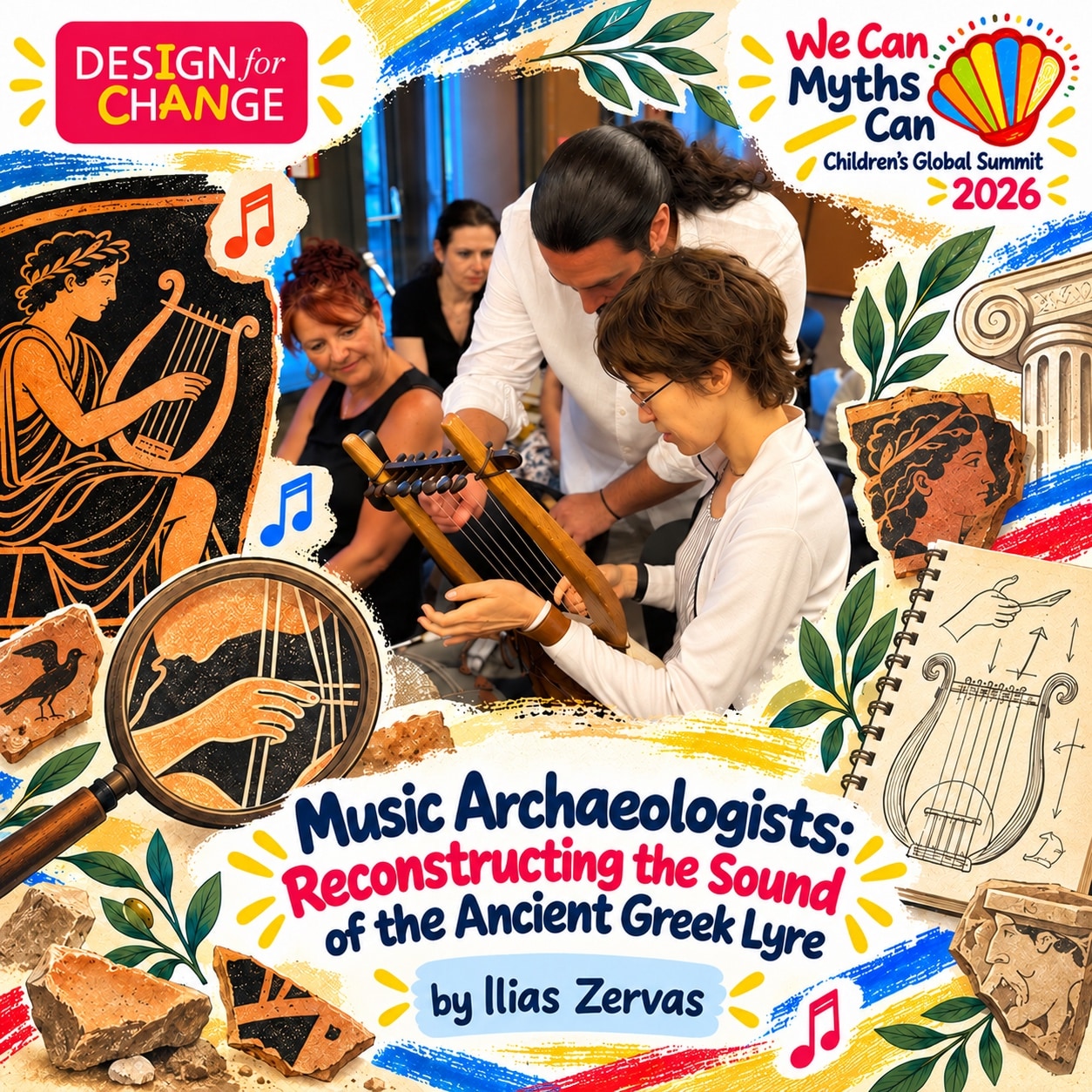
Music Archaeologists: Reconstructing the Sound of the Ancient Greek Lyre
Ilias Zervas Lyre Player, Musician & Researcher & Co-Founder, International Lyre Society
Institution: International Lyre Society (ILS)
No previous musical experience required
How can we understand the way an ancient musical instrument was played when no recordings survive?
In this interactive workshop, participants become “music archaeologists” and investigate ancient Greek vase paintings depicting lyre players. Working in small groups, they will observe posture, hand position, the use of the plectrum, interaction with the strings and other visual clues, while experimenting with real reconstructions of the ancient Greek seven-stringed lyre.
Each group will present its observations and hypotheses, which will then be explored and tested through live demonstrations on the instrument. The workshop concludes with a short performance illustrating some of the playing techniques revealed through the investigation.
Through this process, participants will discover not only how the ancient Greek lyre may have been played, but also how researchers move from archaeological evidence to interpretation, experimentation and living musical practice.
Introduction
How can we hear an instrument from the past? Brief introduction to the ancient Greek seven-stringed lyre and to the idea of reconstructing musical practice through archaeological and iconographic evidence.
Forming the research teams.
Participants are divided into five groups of approximately four people. Each group receives a different image from an ancient Greek vase depicting a lyre player, together with access to a reconstructed lyre.
Music Archaeologists – Investigation.
Each group studies its image and identifies clues concerning how the instrument is held and played: posture, hand position, plectrum use, contact with the strings and other visible details. Participants are encouraged to reproduce possible positions and techniques on the actual instrument and distinguish observation from hypothesis.
Group Presentations.
Each team presents its image, observations and interpretation to the other participants, explaining what they believe the ancient musician may be doing and what evidence supports their conclusions.
Verification and Live Demonstration.
Ilias Zervas revisits the five images, identifying what can be supported by the visual evidence, what can reasonably be inferred and what remains uncertain. The relevant playing techniques are demonstrated live on the ancient Greek seven-stringed lyre.
From Evidence to Music.
Short live performance demonstrating how several of the techniques explored during the workshop can function within an actual musical performance.
What Participants Will Take Away
Participants will gain a practical understanding of the ancient Greek seven-stringed lyre, including how it is held, how sound is produced and how different playing techniques may be identified through ancient visual evidence.
They will also experience first-hand how archaeological and iconographic sources can be used to reconstruct aspects of ancient musical practice, while learning to distinguish between evidence, informed interpretation and modern reconstruction.
Most importantly, participants will have the opportunity to handle and experiment with reconstructed lyres themselves, transforming the ancient instrument from an archaeological image into a tangible, living musical experience.